
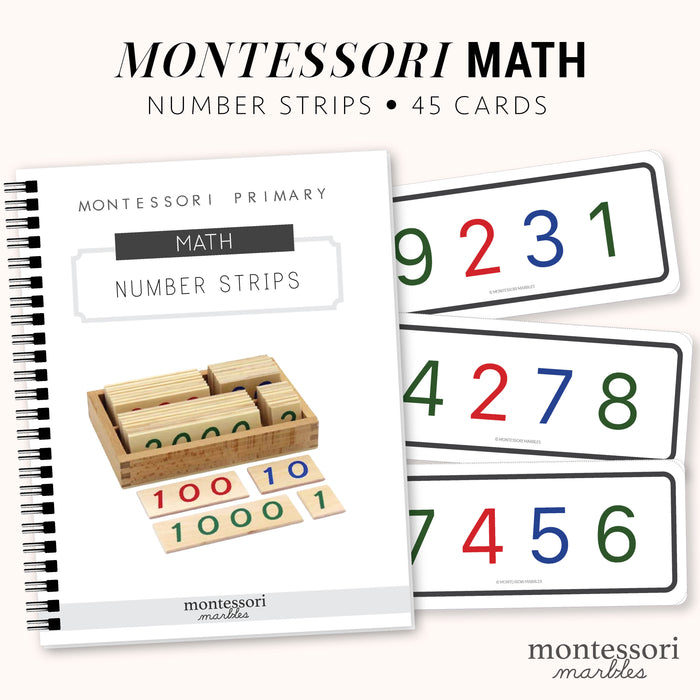


Montessori Number Strips
Digital Download
Enjoy instant access to your Montessori printables. This is a digital product - no physical items will be shipped.
These Montessori number strips are printable PDF place value cards designed for ages 6 to 9, introducing the decimal system through color-coded hierarchical categories. This 45-card set helps children visualize how numbers compose into thousands, hundreds, tens, and ones, bridging the gap between concrete golden bead materials and abstract mathematical thinking.
📦 What's Included
- 45 Number Strips: Complete set for building four-digit numbers
- Thousands Place: Green cards (1000, 2000, 3000, up to 9000)
- Hundreds Place: Red cards (100, 200, 300, up to 900)
- Tens Place: Blue cards (10, 20, 30, up to 90)
- Ones Place: Green cards (1, 2, 3, up to 9)
- Large Format: 7.5 x 3.2 inch strips for easy manipulation
- 15 Print Pages: Ready to cut and laminate for durability
🎯 How to Use Number Strips
- Present after children have worked with concrete golden bead materials and understand the decimal hierarchy
- Begin by showing how strips overlay to create complete numbers (for example, 2000 + 300 + 40 + 5 = 2345)
- Practice building numbers called out by the guide or written on slips
- Have children read the number created by layering their strips from largest to smallest place value
- Use for decomposing larger numbers into component parts, reinforcing place value understanding
- Pair with golden beads initially, then transition to strips alone as abstraction solidifies
🍂 Number Strips in the Montessori Math Sequence
Number strips serve as a transitional material between the concrete golden beads and purely abstract written numbers. After children have exchanged golden beads (ten units for one ten bar, ten tens for one hundred square), they're ready to represent these quantities symbolically. The color coding mirrors the bead colors, creating visual continuity: green for units and thousands, blue for tens, red for hundreds. This repetition of colors across hierarchies introduces the decimal pattern that continues through millions and beyond.
The strips' overlaying design is intentional. When a child places 2000 over 300 over 40 over 5, they physically construct the number 2345, seeing how each place value maintains its position. This concrete representation prevents the common confusion where children see 2345 as "two, three, four, five" rather than understanding the true magnitude of each digit.
🔗 Build Complete Decimal System Understanding
- Golden Beads Nomenclature Cards — Match quantity names to physical bead representations
- Golden Beads Flash Cards — Quick recognition practice for place value quantities
- Beginner Math Workbook — Written practice for numbers 1 to 10 foundations
- Montessori Teens Math Workbook — Bridge work for numbers 11 to 19
📚 Explore Math Collections
- Montessori Beads Collection — All decimal system and golden bead materials
- Numbers Collection — Complete number recognition and counting activities
- Math Collection — Browse all mathematics materials from counting to operations
