
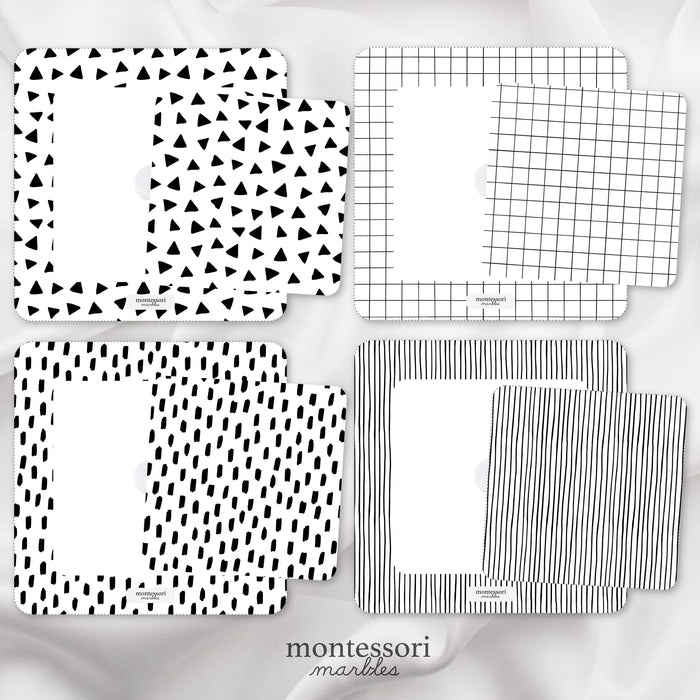


High Contrast Baby Vision Cards | Black White Patterns
Digital Download
Enjoy instant access to your Montessori printables. This is a digital product - no physical items will be shipped.
Your newborn stares intently at light switches, ceiling fans, and the edge of the curtain—but seems uninterested in colorful toys. That's because babies are born seeing mostly shadows and high-contrast edges. Their developing vision can't yet process subtle colors or complex patterns. These high contrast baby vision cards use bold black and white geometric patterns specifically designed for how newborns actually see during their first six months of life. Eight distinct pattern cards support tummy time, visual tracking practice, and early brain development during the critical window when your baby's vision is rapidly maturing.
📦 What's Included
- 8 high-contrast pattern cards: Bold black and white geometric designs optimized for newborn vision
- Large 3.5" x 3.5" size: Easy for babies to see from typical tummy time distance (8-12 inches)
- Varied patterns: Stripes, circles, checkerboards, spirals, and abstract shapes
- Professionally designed: Clean, high-contrast graphics with no distracting details
- 4 printable pages: Print on cardstock or photo paper for durability
- Montessori-aligned: Supports infant's natural visual development stages
- Instant PDF download: Print at home or at a print shop immediately
👶 Why Newborns Need High Contrast Cards
Babies are born with vision that's roughly 20/400—they see the world as blurry shadows and light. During the first three months, they can only see high-contrast patterns about 8-12 inches from their face. Colorful toys, pastels, and subtle designs are essentially invisible to them. Black and white patterns with strong contrast provide the visual stimulation their developing brains need. These cards give your baby something clear and interesting to focus on, supporting crucial neural connections forming in the visual cortex during this sensitive period.
💡 Developmental Benefits
- Visual development: Stimulates the optic nerve and builds neural pathways in the visual cortex
- Focus and concentration: Babies practice sustaining attention on a single object
- Eye tracking: Following patterns supports eye muscle coordination
- Brain stimulation: High-contrast patterns activate more neurons than low-contrast images
- Tummy time engagement: Gives babies a reason to lift their heads and strengthen neck muscles
- Calm focus activity: Provides sensory input without overstimulation
🎯 How to Use These Cards
- During tummy time (0-3 months): Place a card 8-12 inches in front of baby's face while they're on their stomach
- Sitting supported (3-6 months): Hold cards at baby's eye level and slowly move them side to side to encourage tracking
- Propped nearby (any age): Lean cards against objects during diaper changes or on the floor during play
- Rotate patterns daily: Introduce one new card every few days to maintain interest
- Follow baby's lead: Some babies stare for 30 seconds, others for several minutes—both are normal
- Laminate for durability: Baby may grab or mouth cards as they get older
- Use in multiple locations: Keep sets in different rooms (nursery, play area, changing table)
🍼 Perfect Timing for Each Age
- 0-6 weeks: Baby sees only very high contrast, focus on bold stripes and checkerboards
- 6-12 weeks: Vision sharpens, introduce more complex patterns like spirals
- 3-4 months: Babies start seeing some colors, but still prefer high contrast for focused attention
- 5-6 months: Vision approaches adult clarity, cards remain useful for tracking practice
🔍 Montessori Infant Philosophy
Montessori infant environments emphasize simplicity, order, and developmentally appropriate materials. Rather than overwhelming babies with bright, noisy toys, we offer calm, focused activities that match their actual capabilities. High contrast vision cards honor where your baby is right now—not where they'll be in six months. This respectful approach supports natural development without forcing premature skills.
🎁 Perfect for New Parents
- Printable baby shower gift (pair with a picture frame)
- Hospital bag essential for newborn's first days
- Tummy time starter kit component
- Montessori infant classroom material
- Postpartum doula resource for supporting families
- Newborn photography session props
🔍 Teaching Tip from a Montessori Infant Guide
Don't expect your baby to smile, laugh, or react dramatically to vision cards. Newborns show interest through stillness—they stop moving, their eyes widen slightly, and they stare intently. This quiet focus IS the developmental work happening. If your baby turns away or closes their eyes, they're saying "I'm done." Respect that boundary. Vision cards are about quality attention, not duration.
👥 Who This Is For
- Parents of newborns 0 to 6 months old
- Montessori infant communities (Nido programs)
- Postpartum doulas and newborn care specialists
- Pediatric occupational therapists working with infants
- Childcare providers caring for babies under 6 months
- Families preparing for baby's arrival
- Gift-givers seeking developmental toys for newborns
🖨️ Print & Prep Tips
- Print on matte cardstock (110 lb or heavier) for best durability
- Laminate with 3-5 mil laminating pouches for drool resistance
- Cut cards cleanly with sharp scissors or paper trimmer
- Store in a small basket or photo album
- Replace cards if they become damaged (unlimited printing!)
- Visual Skills Activities – observation, matching, and discrimination practice
- Pattern Matching Collection – colorful puzzles for toddlers and preschoolers (18+ months)
- Fine Motor Skills Collection – cutting, tracing, hand coordination activities
- Montessori Primary Materials – activities for ages 3-6
