
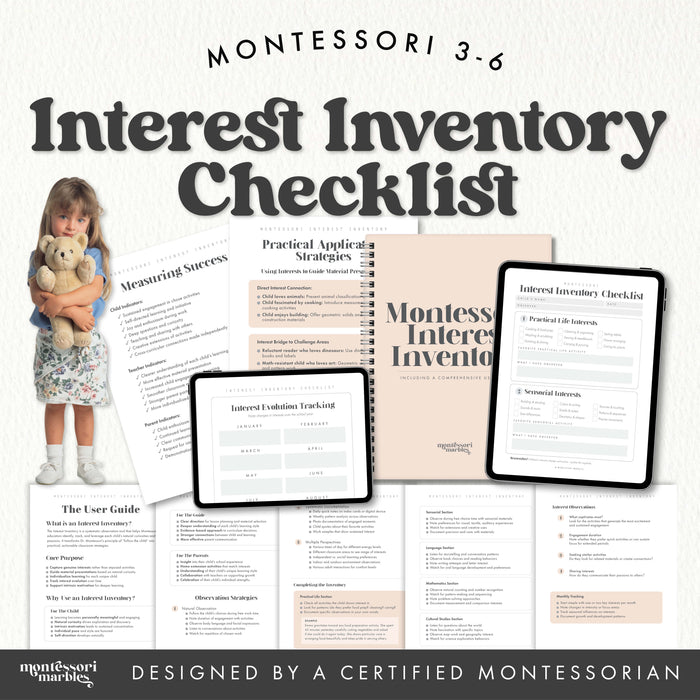


Montessori Interest Inventory Checklist
Digital Download
Enjoy instant access to your Montessori printables. This is a digital product - no physical items will be shipped.
This 19-page student interest inventory is a printable PDF observation system designed for Montessori educators working with ages 3 to 6, helping you turn Dr. Montessori's "follow the child" philosophy into practical classroom strategies. Created by a certified Montessori guide, this teacher assessment tool provides checklists and tracking templates across all five curriculum areas: Practical Life, Sensorial, Language, Mathematics, and Cultural Studies.
📦 What's Included
- 19-Page Educator Guide: Step-by-step observation techniques with real classroom examples
- Subject-Specific Checklists: Track student interests in Practical Life, Sensorial, Language, Math, and Cultural Studies
- Monthly Progress Templates: Document how interests evolve and shift over time
- Learning Style Assessment Forms: Identify individual energy patterns and work preferences
- Documentation Strategies: Multiple methods for busy classrooms (quick notes, detailed observations, pattern tracking)
💡 Benefits for Your Classroom
- Make lesson planning decisions based on documented student interests rather than assumptions
- Identify which materials to rotate onto shelves based on actual engagement patterns
- Share concrete examples with parents during conferences instead of vague observations
- Recognize when a child is ready for new challenges or needs support in a particular area
- Build stronger relationships by demonstrating genuine understanding of each learner
🎯 How This System Works
Rather than relying on memory or scattered notes, this observation framework helps you document what you're already noticing. Use the checklists during work periods to note which materials children gravitate toward, how long they sustain concentration, and which activities they avoid. The monthly templates reveal patterns you might miss day-to-day, like a child who returns to the same sensorial work repeatedly or one who suddenly develops interest in a previously ignored math material.
The system respects the reality of busy classrooms. You're not expected to complete lengthy forms for every child daily. Instead, focus observation efforts strategically, cycling through your class over weeks rather than attempting comprehensive documentation all at once.
👥 Who This Resource Serves
- Montessori guides in Casa (3-6) environments seeking systematic observation methods
- New teachers building their observation and documentation skills
- Experienced guides wanting to strengthen parent communication with data
- Montessori homeschool parents tracking multiple children's interests and progress
- Teacher trainers demonstrating practical applications of observation techniques
🍂 Why Observation Matters in Montessori
The phrase "follow the child" sounds simple, but requires disciplined observation practice. Without systematic documentation, we risk following our assumptions rather than the actual child in front of us. This inventory helps you notice the quiet child who works deeply with practical life every morning, or recognize when a previously disinterested student suddenly develops mathematical curiosity. These insights inform everything from lesson presentations to shelf organization to parent conversations. Observation isn't paperwork; it's the foundation of responsive Montessori education.
🔗 Complete Your Teacher Toolkit
- Montessori Teacher Planner — Daily lesson planning, weekly scheduling, and presentation tracking for Primary classrooms
- Montessori Primary Curriculum Checklist (Ages 3-6) — Complete scope and sequence for all five curriculum areas
- Montessori Toddler Curriculum Checklist (Ages 1-3) — Developmental milestones and activities for younger learners
- Montessori Elementary Curriculum Checklist (Ages 6-12) — Lower elementary scope and sequence across all subjects
